Why Giving Tenants Your Personal Mobile Number Is a Risk
Most landlords start the same way: a new tenant needs a way to reach you, so you give them your mobile number. It's quick, it's free, and it works — right up until it doesn't.
The number you hand over doesn't come back
A phone number, once given, isn't something you can take back. Unlike a key or a login, there's no way to revoke it — a tenant who has your personal mobile keeps it for as long as they want, tenancy or no tenancy. That's true of the tenant directly, and it's also true of anyone they've forwarded it to, saved it under a shared contact, or mentioned it to: a partner, a flatmate, a friend chasing a deposit query on their behalf.
For a landlord managing a handful of properties personally, that adds up quickly. Every tenant across every property, past and present, has a live line to you at any hour, for anything — not just the maintenance issue they originally called about.
Boundaries are hard to set after the fact
It's much easier to start a tenancy with a number that has clear rules attached than to try to retrofit boundaries onto a personal mobile a tenant already has. Telling an existing tenant "please don't call after 8pm" relies on them remembering and choosing to respect it. A dedicated number can just enforce that automatically:
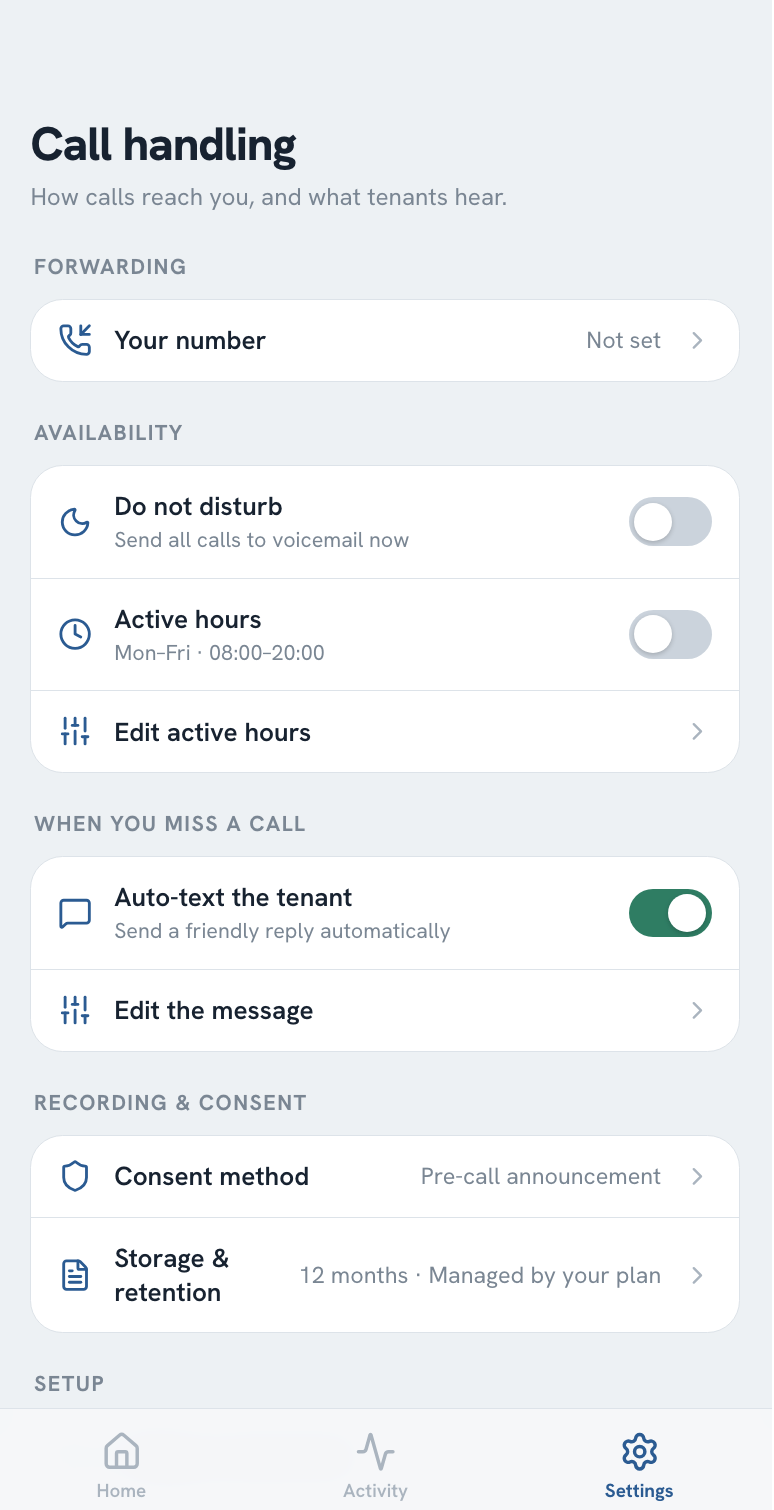
- Active hours route calls straight to voicemail outside the times you've set, instead of ringing your personal phone at 11pm
- Do not disturb gives you a manual override for evenings, holidays, or just a day off, without switching your actual phone to airplane mode
- Auto-text on a missed call means a tenant who calls outside hours still gets an acknowledgement, so "no answer" doesn't read as "ignored" — on a number that supports SMS and as long as your monthly text allowance isn't exhausted, since that reply is a text too
None of this requires a second handset or a business contract — a dedicated number forwards to the phone you already carry, with these rules applied before a call ever reaches you.
A separate number is also a paper trail
A personal mobile number gives you no record of what was said or when. A dedicated landlord number, with consent-based recording and a retention period attached, means a disputed claim about a missed report or a late-night call has something behind it other than two conflicting memories. That's a small thing until the one time it isn't.
Getting started
If you're currently using your personal mobile for tenant calls, switching doesn't mean changing your number or buying new hardware — it means putting a dedicated number in front of the one you already have. Our pricing page covers what's included at each tier, and the Get Started page is the quickest way to ask questions specific to your portfolio. For the wider legal picture on landlord responsibilities, the UK government's landlord guidance is a useful starting point.
Frequently asked questions
Should landlords give tenants their personal mobile number?
It's generally worth avoiding. A personal number handed to a tenant stays with them indefinitely — through the tenancy, after it ends, and often after it's passed on to whoever they mention it to. A dedicated landlord number keeps calls and texts reachable without tying tenant contact to a number you also give to family, friends, and everyone else.
What happens to my personal number once a tenancy ends?
Nothing, by default — the tenant simply keeps it. There's no built-in way to revoke a phone number the way you'd remove someone's access to a shared document or account, so any number given to a tenant is effectively given to them permanently, whether or not the tenancy continues.
Can I change a landlord number later without affecting my personal phone?
Yes — that's the main practical advantage over handing out a personal mobile. A dedicated number can be retired, reassigned to a different property, or reset if a situation calls for it, all without touching the personal number you use for everything else.