Phone Answering Service or Virtual Number: What Fits a Small Landlord?
Once you've decided tenants shouldn't call your personal mobile, a live phone answering service can look like the obvious fix — a human picks up on your behalf, so no call from a tenant ever goes unanswered. For a landlord with a handful of properties, though, it's solving a narrower problem than it first appears, and it comes with trade-offs that don't show up until you're a few months into using one.
What a phone answering service actually does
You give the provider a script — your name, a line about the property or portfolio, maybe a note on how to handle an emergency — and their staff answer calls on your behalf during agreed hours, take a message, and pass it on to you afterwards, usually by text or email. It's a genuine person on the other end of the line, which is exactly the appeal: a tenant never hits voicemail.
Where it doesn't quite fit a small landlord
The catch is that the operator answering the call is working from a script, not from knowledge of your property. They can't tell a tenant whether the boiler engineer is already booked for Thursday, or whether a noise complaint about the flat upstairs has come up before — anything beyond the script has to wait for you to call back, which puts you back roughly where a missed call would have left you, just with a message already taken.
Cost is the other practical difference. Most services charge a per-minute rate layered on a monthly retainer, or a tier based on expected call volume, so the bill moves with how much tenants actually call — hard to predict for a landlord whose call volume varies month to month. A virtual number plan is typically a flat monthly fee for a pooled allowance of minutes and texts, rather than a per-call charge on top of the base fee — so as long as usage stays inside that allowance, which it usually does at this scale, the monthly cost doesn't move the way a per-minute/retainer bill does. On TenantCall, going over your minutes doesn't mean going dark either: it only affects live call forwarding, while voicemail, transcription, and the missed-call text reply (on a number that supports SMS) keep working regardless (that reply draws on your text allowance, not your minutes). Texts are more clear-cut — going over your text allowance means texts, including that same missed-call reply, stop sending and receiving until usage resets, or immediately if you upgrade to a larger plan with immediate effect.
There's also no automatic record beyond whatever message the operator writes down. The call itself generally isn't recorded or transcribed, so what you get is a summary in someone else's words, not what the tenant actually said — and that summary isn't filed against the specific property on its own, so a searchable history per address is something you'd have to build yourself rather than something that comes with the service. And because the call log and message history live in the provider's system rather than somewhere you hold directly, switching providers later can mean losing easy access to that record rather than taking it with you.
Where a virtual number differs
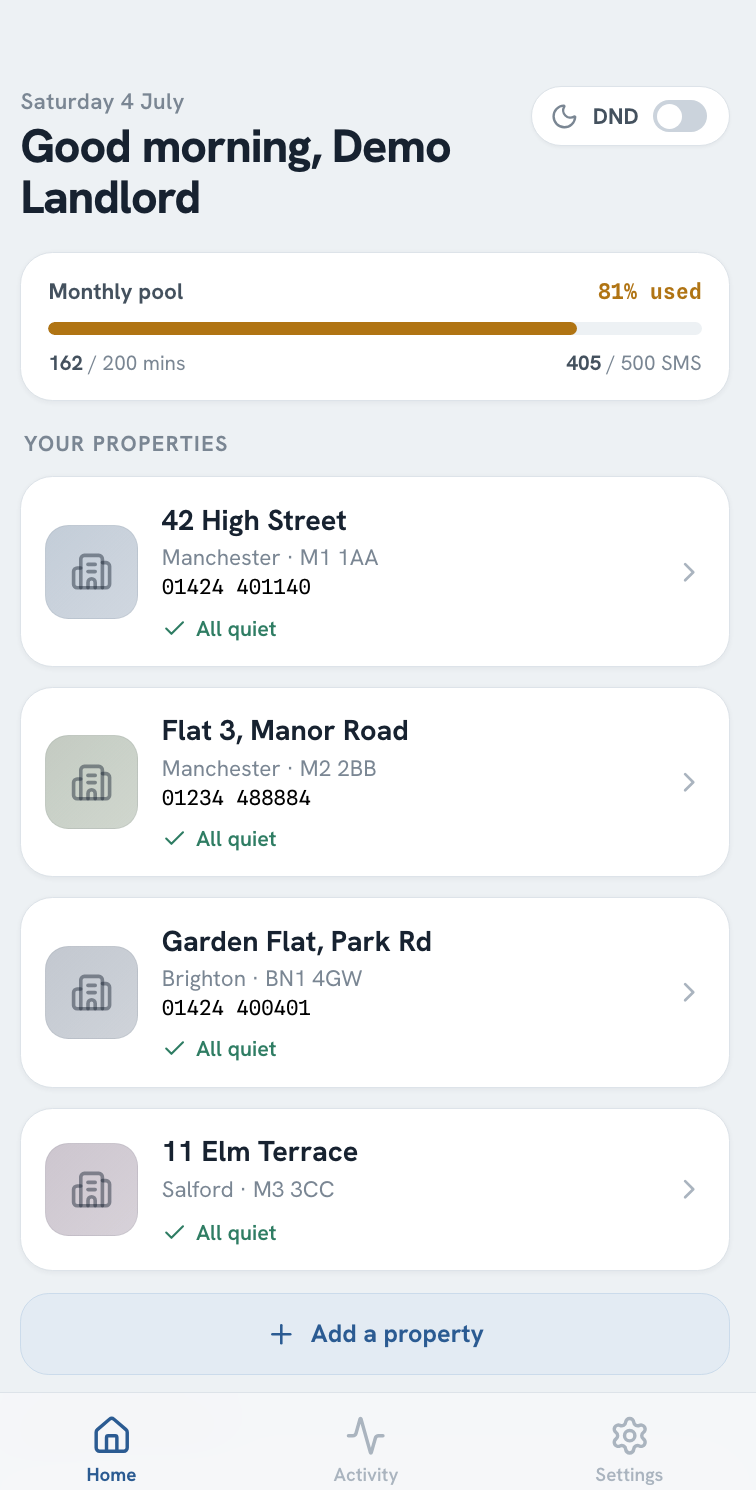
A virtual landlord number, like TenantCall, isn't a person answering on your behalf — it's still you (or whoever you designate) taking the call, just through a number with call-handling rules built in: active hours, an automatic text reply on a missed call (on a number that supports SMS, as long as your text allowance isn't exhausted), and voicemail that lets an urgent message stand out from a routine one. You're never paying per minute for someone else's time on the phone, and there's no script standing between the tenant and someone who actually knows the tenancy.
Every call routed through TenantCall — answered or missed — is transcribed and filed against the property it came from, on a consent basis and in your own account rather than a third party's system, so there's a searchable record of what was actually said on each call, not a paraphrased message. That's useful day to day for keeping track of what a contractor promised, and it matters considerably more the one time a call becomes disputed.
Comparing the two
| Phone answering service | Virtual number | |
|---|---|---|
| Who answers | A third-party operator | You (or whoever you designate) |
| Knows the specific property/tenancy | No — works from a script | Yes — it's still you on the call |
| Pricing | Per-minute/retainer, scales with call volume | Flat fee for a pooled minutes/SMS allowance |
| Call recorded and transcribed | Usually not — a written summary instead | Yes, on a consent basis |
| Filed automatically against the property | No | Yes |
| Record held directly by you | No — sits in the provider's system | Yes |
Which one actually fits
A phone answering service earns its cost when you genuinely can't take any calls yourself — heavy travel, a large portfolio, or a period where you need someone else's voice on the line. Even then, the two aren't mutually exclusive: a virtual number's forwarding isn't locked to your own mobile, so pointing it at an answering service for that period, then switching it back once you're reachable again, is a plan setting rather than a decision you're stuck with either way. For a landlord managing a handful of properties who mostly wants calls off their personal mobile and a boundary on when they ring, a virtual number covers the same "never miss a tenant call" goal without the per-minute cost, the script standing between you and the tenant, or losing your own record of what was actually said.
Getting started
Our pricing page breaks down what's included at each tier, and the Get Started page is the quickest way to ask which option fits your specific number of properties.
Frequently asked questions
How much does a phone answering service cost for a landlord?
Most answering services charge either a per-minute rate on top of a monthly retainer, or a tiered plan based on how many calls you expect them to take — so cost scales with call volume in a way that's hard to predict in advance. A virtual number plan typically charges a flat monthly fee for a pooled allowance of minutes and texts sized for normal use, rather than billing per call on top of the base fee, which tends to make the monthly cost easier to plan around for a landlord with only a handful of properties and a modest, fairly steady number of tenant calls.
Will a call answering service know details about my property or tenancy?
Not usually beyond whatever script or notes you give the operator in advance. The person answering is typically handling calls for many different clients across the day, so they can confirm your name and take a message, but they generally can't speak to specifics like which contractor is already booked for a repair or what was agreed on a previous call — that context has to come from you afterwards, the same as if a stranger had picked up.
Does a phone answering service record and transcribe every call?
Most answering services take a written message rather than recording and transcribing the call itself, and what they pass on is a summary the operator wrote, not the tenant's own words. That summary usually isn't filed against the specific property automatically either, so building a searchable per-property history takes extra manual work on your part rather than happening on its own.
If I stop using an answering service, do I keep a record of past calls?
That depends on the provider, but in most cases the call log and any message history live in the answering service's own system, not somewhere you hold directly — so switching away can mean losing easy access to that history rather than taking it with you. It's worth checking a provider's data export or retention policy before signing up if keeping your own record matters to you.
What happens if I go over my minutes or SMS allowance on a virtual number plan?
On TenantCall, going over your monthly minutes only affects live call forwarding — voicemail, transcription, and the missed-call text reply (on a number that supports SMS) keep working regardless, so a tenant's call is still captured and you're still alerted to it (that reply draws on your text allowance, not your minutes, so a minutes overage doesn't touch it). Going over your text allowance is more clear-cut: texts, including that same missed-call reply, stop sending and receiving until your usage resets, or immediately if you upgrade to a larger plan with immediate effect. Either way, that's a different failure mode to running short with a per-minute answering service, where extra usage means an extra charge rather than a feature switching off.
Can I use a virtual number with an answering service instead of choosing one or the other?
Yes — a virtual number's forwarding isn't locked to your own mobile, so it can be pointed at an answering service's number for a period you genuinely can't take calls yourself, such as heavy travel, then switched back to your own mobile afterwards. That way the answering service is a temporary layer behind the number rather than a full replacement for it, and everything the number itself handles — voicemail, transcription, filing calls against the property — keeps working regardless of where forwarding is pointed.