Second SIM, Dual-SIM Phone, or Virtual Number: What Fits a Small Landlord?
Once you've decided tenants shouldn't have your personal mobile number, the next question is which second number to actually get. For a landlord managing a handful of properties, that usually comes down to three practical options — not two — and they trade off differently on cost, day-to-day hassle, and what happens once you no longer need the number.
A second SIM card
The most familiar option: a pay-as-you-go SIM or a cheap second contract, either dropped into a spare phone or swapped into your main handset when you need it. It's the lowest ongoing cost of the three, often just a few pounds a month for light use.
The trade-off shows up in daily use. A spare phone is another device to keep charged and remember to check; swapping SIM trays back and forth isn't something most people keep doing for long. And a SIM on its own has no concept of working hours — it rings whenever it rings, at 7am or 11pm, with nothing in between to route the call anywhere else.
A dual-SIM phone
Most modern phones support two active numbers at once (a physical SIM plus an eSIM, or two physical SIMs), so a second number can sit on the same handset you already carry — no spare device, no tray-swapping.
That solves the "which phone is it on" problem but not the boundary one: both numbers still ring the same phone, at the same hours, with no automatic rule to send the tenant line to voicemail after a set time. Quieting it for an evening means finding the setting and switching that line off yourself, then remembering to switch it back on. It also has a hard ceiling — once you're past two or three properties, a phone with two SIM slots runs out of numbers before your portfolio does.
A virtual number
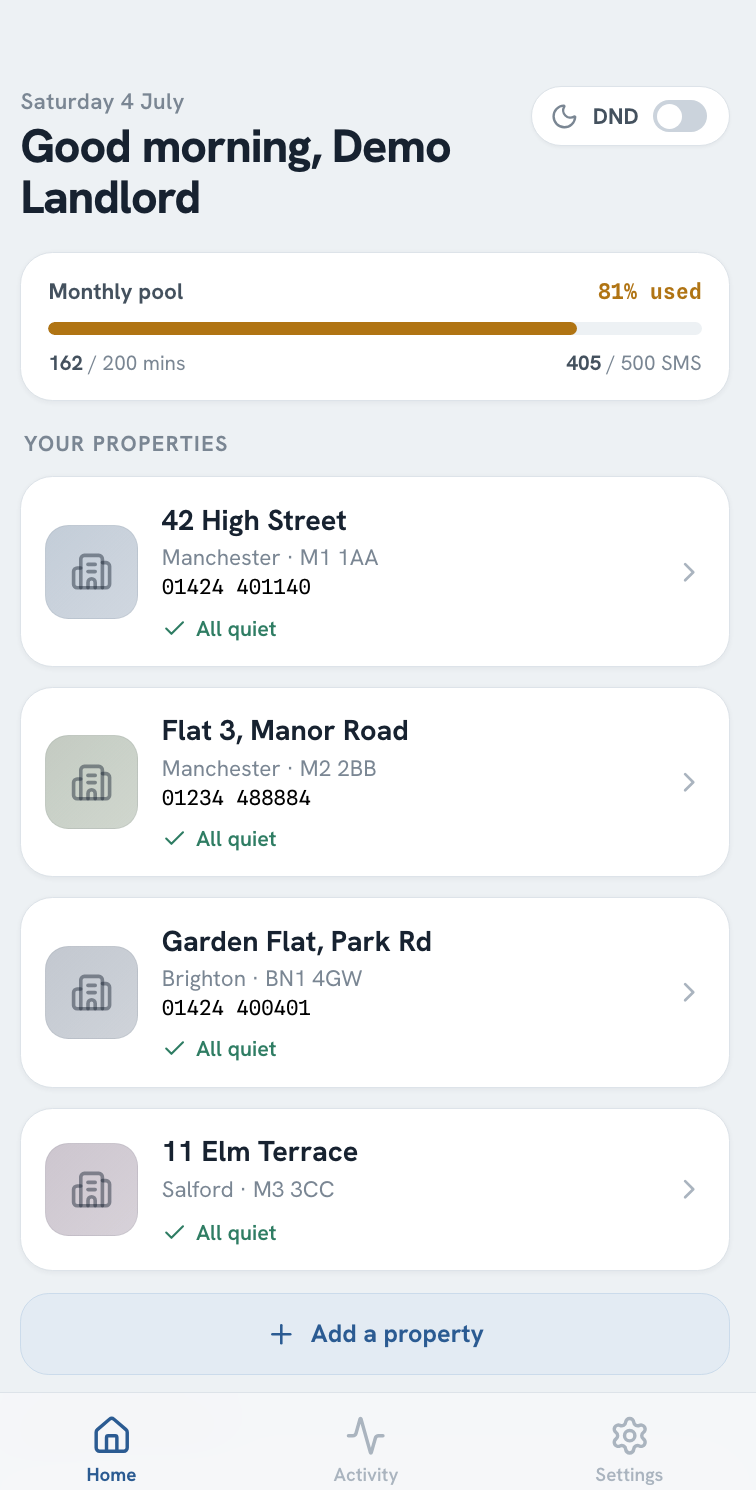
A virtual landlord number, like TenantCall, forwards to the phone you already carry — no new SIM, no spare handset, no second line to manage on the device itself. The difference is what happens before a call reaches you: active hours, do-not-disturb, and an automatic text reply on a missed call (that reply needs a number that supports SMS, and keeps working as long as your monthly text allowance isn't exhausted) are rules the number itself enforces, rather than something you have to remember to do manually every evening.
It also handles things a personal number or a bare SIM plan simply has no mechanism for. Calls can be recorded, on a consent basis. Every call routed through the number — answered or missed, tenant or contractor or letting agent — is transcribed and filed against that property, so instead of trying to remember what was agreed on a call three weeks ago, there's a searchable record of every conversation tied to that address in one place. That's useful for everyday organisation (chasing up what a tradesperson actually said they'd do) and it's the kind of thing that matters a great deal more the one time a call ends up disputed.
And on plans that support it, if a call goes to voicemail outside your active hours, the caller can flag their message as urgent so it stands out from routine messages instead of getting buried among them — something a SIM card or a phone's second line has no way to do at all, since there's nothing behind either one but the number itself.
It also scales the way a portfolio does rather than the way a phone's SIM slots do — adding a property means adding a number to the same plan, not sourcing another SIM or another phone for it.
Comparing the three
| Second SIM | Dual-SIM phone | Virtual number | |
|---|---|---|---|
| Extra hardware | Often a spare phone | None | None |
| Built-in call-hours/do-not-disturb | No | No | Yes |
| Automatic reply on a missed call | No | No | Yes |
| Records calls on a consent basis | No | No | Yes |
| Every call routed through the number is transcribed and filed against the property | No | No | Yes |
| Lets a caller flag a voicemail as urgent | No | No | On some plans |
| Scales past 2 properties easily | No | No | Yes |
| Can be retired without touching your personal number | Depends on the SIM | Yes | Yes |
Which one actually fits
If you have a single property, rarely get a tenant call, and don't mind manually silencing a line in the evenings, a second SIM or a dual-SIM phone can be enough — the cost is lower and the setup is something you already understand. Past one property, or once evening calls become a genuine annoyance rather than a rare interruption, the built-in hours, do-not-disturb rules, and a filed, transcribed record of every call routed through the number tend to save more day-to-day hassle — and leave you with more to fall back on — than a bare SIM or a dual-SIM phone ever will.
Getting started
Our pricing page breaks down what's included at each tier as your portfolio grows, and the Get Started page is the quickest way to ask which option fits your specific number of properties.
Frequently asked questions
What's the cheapest way to get a second number for tenants?
A pay-as-you-go SIM is usually the cheapest option month to month, often a few pounds a month if you barely use it. The catch is you need somewhere to put it — a spare handset you keep charged and check, or repeatedly swapping the SIM tray in your main phone — and it comes with none of the call-routing rules (active hours, do-not-disturb, automatic replies) that a dedicated landlord number can enforce on its own.
Can I use a dual-SIM phone instead of a virtual number?
You can, and it avoids carrying a second handset, but both numbers still ring the same phone with no automatic rule for after-hours or busy periods — muting the tenant line means manually toggling it off in your phone's settings each time, not something that happens on its own. Most phones also cap out at two active lines, which becomes a limit in itself once you're managing more than one or two properties.
Does a virtual number cost more than a second SIM?
A bare SIM-only plan is usually cheaper on paper, but it's not really comparing like for like — a virtual number plan bundles the number with voicemail, a pooled allowance of minutes and texts, and built-in call-handling rules, and one plan can cover several properties at once rather than paying for a separate SIM per property.
If I set do-not-disturb hours, will I still find out about a genuine emergency?
On plans that support it, if a call goes to voicemail during your off hours, the caller can flag their message as urgent before they leave it, and it's marked clearly so it doesn't sit alongside routine messages when you next check. Even then, that only tags the message rather than ringing through live or alerting you immediately, so for something like a suspected gas leak or a break-in, it's worth telling tenants upfront to call 999 or the relevant emergency service directly rather than relying on any phone system to make that judgement call for them.